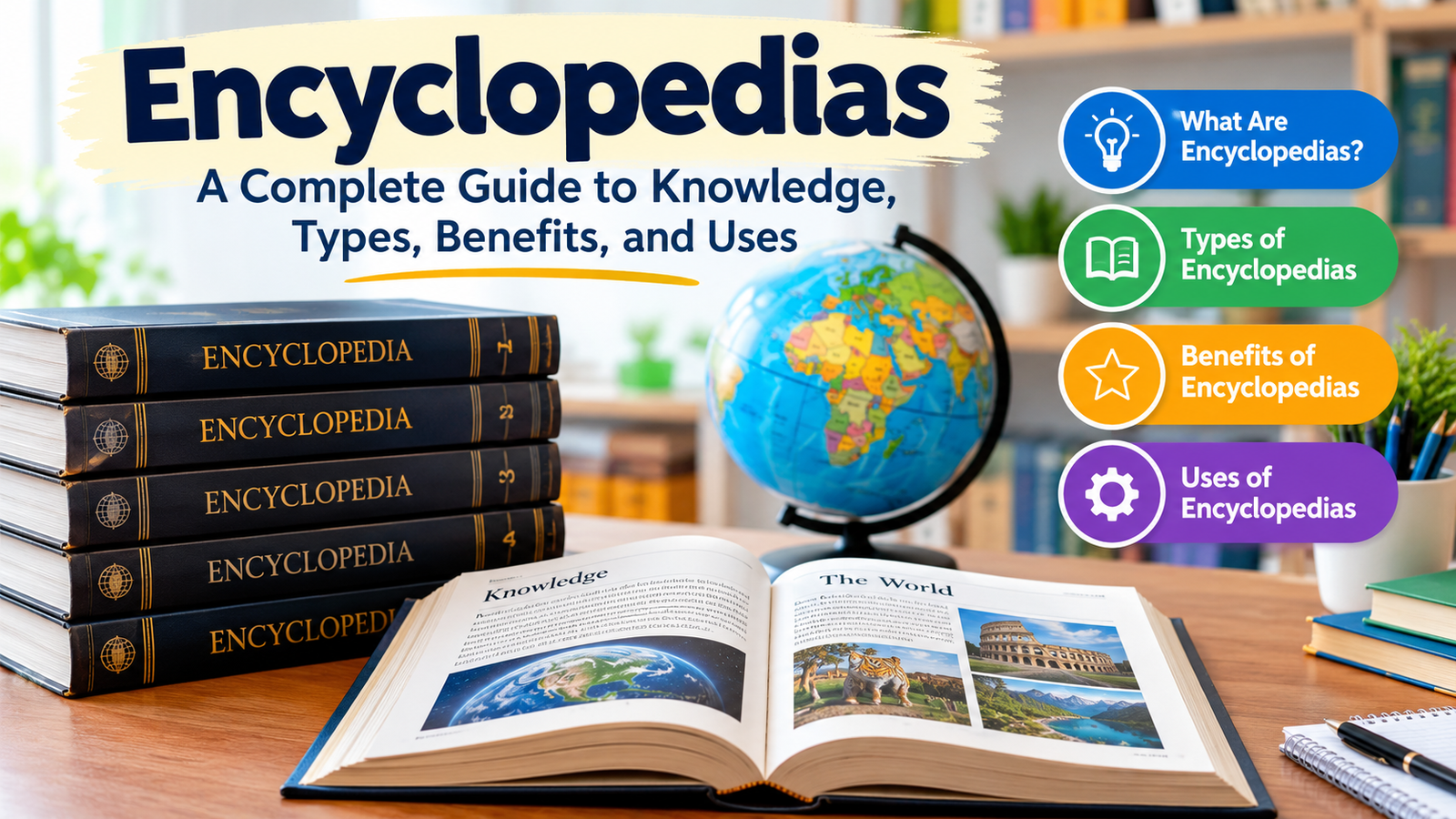
Encyclopedias are useful sources of information that help people understand the world around them. They explain topics in a clear, organized, and easy-to-read way. You can explore history, science, nature, technology, art, and many other subjects. Students use them for school projects, while adults use them to learn new things. Some versions are available in printed books, while others can be accessed online.
Today, finding information is easier than ever. However, knowing which information to trust is still important. Encyclopedias help readers build basic knowledge before exploring a subject in greater detail. They usually present facts, explanations, and summaries instead of personal opinions. Many also include pictures, maps, charts, and helpful examples. Whether you prefer books or digital resources, these reference tools can make learning more enjoyable and organized.
What Are Encyclopedias?
Encyclopedias are reference works that collect information about many subjects or focus on one specific field. Their main purpose is to explain important facts in a structured and understandable format. Entries may cover people, places, events, inventions, animals, scientific ideas, and cultural traditions. Each entry gives readers a starting point for understanding its topic.
For example, an entry about the solar system might explain the Sun, planets, moons, and other objects in space. A history entry might describe an important event, its causes, and its effects. These explanations help readers understand unfamiliar subjects without reading an entire textbook. Encyclopedias can be general or specialized, depending on their purpose. They are especially useful when you need a quick overview before beginning deeper research.
A Brief History of Encyclopedias
The idea of collecting knowledge in an organized form dates back thousands of years. Ancient scholars gathered information about nature, medicine, philosophy, and everyday life. Over time, writers created larger reference works to preserve and share this knowledge. The invention of printing made books easier to produce and distribute, helping reference materials reach more readers.
As education expanded, encyclopedias became important resources in homes, schools, and libraries. Printed editions often contained several large volumes arranged alphabetically or by subject. Later, computers and the internet changed how people accessed reference information. Digital encyclopedias made searching faster and allowed publishers to update content more easily. Today, readers can explore articles on computers, tablets, and smartphones. This development has made general knowledge available to people across many parts of the world.
Different Types of Encyclopedias
There are several types of encyclopedias, each designed to meet different learning needs. General encyclopedias cover many subjects, including geography, history, science, literature, and culture. They are helpful for readers who want a broad understanding of different topics. Specialized encyclopedias focus on one area, such as medicine, technology, music, or animals.
Children’s encyclopedias use simple words, colorful pictures, and short explanations. Academic reference works often provide more detailed information for advanced readers. Online encyclopedias offer searchable entries and may include videos, links, and interactive features. Printed editions remain useful for readers who enjoy physical books or need access without an internet connection. Choosing the right type depends on your age, reading level, research purpose, and preferred learning style.
Printed Encyclopedias and Online Encyclopedias
Printed encyclopedias provide information in physical books. Readers can turn pages, highlight important passages, and study without a screen. They are useful in classrooms, libraries, and homes with limited internet access. However, printed editions can become outdated because new discoveries and events occur over time. They also require storage space and may be expensive to replace.
Online encyclopedias provide digital articles that readers can search within seconds. Many offer links to related topics, photographs, diagrams, and additional references. Some resources update their content regularly, while others have limited editorial updates. Digital access can be convenient, but internet access and device availability may affect users. Neither format is automatically more accurate than the other. Readers should check the publisher, publication date, references, and editorial standards before relying on information.
Popular Examples of Encyclopedias
Several well-known reference resources serve different audiences and purposes. Encyclopaedia Britannica is recognized for its editorial process and broad coverage of academic subjects. Wikipedia is a free online encyclopedia that allows volunteer editors to contribute and improve articles under its publishing rules. Its articles can be useful starting points, but important claims should be checked against reliable sources.
World Book Encyclopedia has traditionally served families, students, and schools through accessible reference content. Specialized encyclopedias also cover subjects such as animals, literature, religion, and scientific research. Each resource has its own strengths, access rules, and methods of reviewing information. Readers should compare sources when accuracy matters. Using more than one trusted reference can help identify missing details and provide a fuller understanding of complicated subjects.
Benefits of Using Encyclopedias
Encyclopedias help people learn about unfamiliar topics without needing to read lengthy books first. They present information in organized entries, making it easier to find key facts. Students can use them to understand lessons, prepare assignments, and discover useful research terms. Teachers can also use reference articles to introduce new subjects during classroom discussions.
Another benefit is their wide range of topics. A single general encyclopedia may introduce readers to science, geography, history, art, and culture. This variety encourages curiosity and lifelong learning. Encyclopedias can also help readers identify questions for further research. For example, a short article about climate may lead someone to explore weather patterns or environmental protection. However, reference entries should support learning rather than replace careful research when a topic requires detailed evidence.
How Students Can Use Encyclopedias
Students can use encyclopedias to build background knowledge before starting a school project. First, they should identify the main question they need to answer. Next, they can search for a relevant entry and read the introduction carefully. Important facts, unfamiliar words, and useful names can be written in notes. Students should then follow reliable references to learn more about the subject.
For example, a student studying ancient Egypt might begin with an overview of its rulers, daily life, and major buildings. The student can then investigate specific historical events using books and trusted educational sources. Copying full paragraphs is not a good research method. Instead, students should explain ideas in their own words and record where the information came from. This approach supports better understanding, stronger writing skills, and responsible academic work.
Encyclopedias for Children
Children’s reference books introduce young readers to new ideas through simple explanations and engaging illustrations. They may include colorful pictures, diagrams, maps, and short activities. These features can make difficult subjects easier to understand. Topics often include animals, planets, the human body, famous inventions, and world geography.
Parents and teachers can help children use these resources by asking questions during reading. For example, after reading about whales, a child might explain where they live or what they eat. This conversation encourages children to remember facts and think more deeply. Adults should also help young readers understand that not every website provides trustworthy information. Age-appropriate resources, clear language, and reliable editorial standards make learning safer and more effective.
The Role of Encyclopedias in Research
Encyclopedias are valuable starting points for research because they provide summaries of larger subjects. Researchers can use them to learn basic definitions, understand important events, and discover relevant terms. Entries may also identify influential people, key dates, and major developments. These details help researchers decide which questions deserve further investigation.
However, encyclopedias do not always provide enough detail for advanced academic work. A summary may leave out disagreements, new findings, or technical information. For important projects, readers should consult original studies, academic books, reputable journals, and primary sources when appropriate. They should also examine the references listed in an entry. Combining introductory information with stronger supporting evidence creates a more complete and balanced understanding of a subject.
How to Check Encyclopedia Information
Not every reference article is equally accurate or current. Readers should examine who publishes the resource and whether qualified editors review its content. The article’s publication or revision date is also important, especially for science, medicine, technology, and current events. References provide another way to judge whether claims have suitable support.
A useful habit is to compare important facts with two or more reliable sources. If the information concerns health or safety, consult qualified professionals and authoritative medical resources. For historical questions, look for reputable scholarship and relevant primary documents. Online articles that provide no sources require extra care. Readers should also separate confirmed facts from estimates or disputed interpretations. These simple checks can reduce mistakes and encourage responsible use of information.
Encyclopedias in the Digital Age
Technology has changed how people find and share knowledge. Digital reference platforms allow users to search titles, keywords, and related subjects quickly. Some provide audio, videos, interactive maps, and links to additional reading. These features can help people with different learning needs explore information in ways that suit them.
Digital publishing also creates challenges. Articles may contain errors, incomplete references, or outdated claims. Search results can make an unreliable page appear alongside trustworthy resources. Readers should therefore evaluate the source rather than trust the first result automatically. Digital encyclopedias work best when users read carefully and verify important information. As technology continues to develop, reference platforms may offer more interactive learning tools while keeping accuracy and clear explanations at the center of their work.
Encyclopedias Compared With Dictionaries and Textbooks
Encyclopedias, dictionaries, and textbooks serve different purposes. A dictionary mainly explains word meanings, spelling, pronunciation, and usage. An encyclopedia provides broader information about a subject, including its background and importance. A textbook follows a learning plan and usually explains a subject through lessons, examples, exercises, and assessments.
Imagine that you want to learn about volcanoes. A dictionary can explain what the word means. An encyclopedia can describe how volcanoes form, where they occur, and why they erupt. A textbook may teach these ideas through a full science unit with diagrams and activities. These resources work well together. Understanding their differences helps readers choose the right tool for each task and avoid using a brief reference entry when deeper study is needed.
The Future of Encyclopedias
The future of encyclopedias will likely involve more digital features and flexible ways to explore information. Search tools can help readers find related ideas, while multimedia content can explain complex topics through pictures and demonstrations. Improved accessibility features may also help more people use reference materials. These changes can make learning easier for students, teachers, families, and independent readers.
Still, technology alone cannot guarantee accurate information. Good reference works need careful editing, clear sourcing, regular reviews, and honest explanations of uncertainty. Readers will continue to need skills for checking facts and comparing evidence. The most useful encyclopedias will combine convenient access with responsible publishing. Their central purpose will remain the same: helping people understand the world through organized, reliable, and accessible knowledge.
Conclusion
Encyclopedias remain useful tools for anyone who wants to explore new subjects and build general knowledge. They organize information into clear entries that help readers understand unfamiliar ideas. Printed books offer a traditional learning experience, while online resources provide fast searching and convenient access. Both formats can support education when readers choose reliable sources and check important facts.
Whether you are a student, teacher, parent, or curious reader, begin with a topic that interests you. Read an introductory entry, note the key ideas, and explore trustworthy references for more detail. Use reference materials as a starting point for asking better questions and discovering new information. With careful reading and thoughtful research, you can turn everyday curiosity into lasting knowledge.
Frequently Asked Questions (FAQs)
1. What are encyclopedias used for?
Encyclopedias provide organized information about people, places, events, and subjects. They help readers understand unfamiliar topics and find starting points for further research. Students often use them for school projects, while other readers use them to expand their general knowledge.
2. Are online encyclopedias reliable?
Many online encyclopedias provide useful information, but their reliability depends on their editorial process and sources. Check the publisher, references, and revision date before trusting important claims. Compare information with other reputable sources when accuracy matters.
3. What is the difference between general and specialized encyclopedias?
General encyclopedias cover a wide range of subjects, including science, history, geography, and culture. Specialized encyclopedias focus on one field, such as medicine, literature, or technology. The best choice depends on the information you need.
4. Can students use encyclopedias for school assignments?
Yes, students can use them to understand a topic and identify important facts. They should write notes in their own words and follow their school’s citation rules. Teachers may also require academic books or other sources to support detailed claims.
5. What is the difference between an encyclopedia and a dictionary?
A dictionary explains words, including their meanings, spelling, and pronunciation. An encyclopedia explains subjects in greater detail. For example, a dictionary defines a planet, while an encyclopedia may describe its structure, history, and place in the solar system.
6. How can I choose a trustworthy encyclopedia?
Choose a resource with clear editorial standards, reliable references, and recent updates when needed. Consider the publisher’s reputation and the subject’s complexity. For important research, compare its information with other trusted sources rather than relying on one article alone.